What are the CQC fundamental standards?
The fundamental standards are the standards below which care must never fall. They are set out in regulations 9 to 20A of the Health and Social Care Act 2008 (Regulated Activities) Regulations 2014, and cover person-centred care, visiting, dignity, consent, safety, safeguarding, food and drink, premises, complaints, governance, staffing, fit and proper staff, candour and displaying ratings.
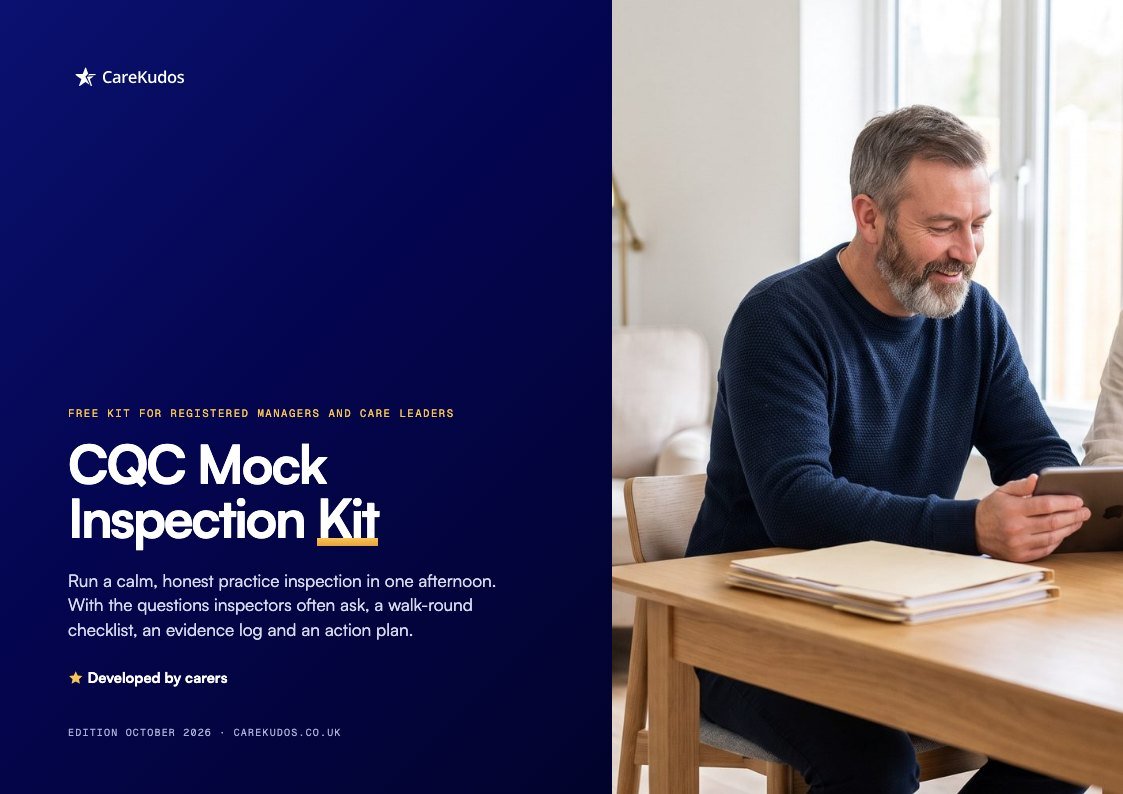
CQC checks that a provider is likely to meet them before it registers a service, and assesses against them afterwards. To see how your service measures up today, the free CQC mock inspection kit walks you through a practice inspection in about half a day.
The fundamental standards at a glance
| Regulation | Standard | What it asks of your service |
|---|---|---|
| 9 | Person-centred care | Care that is tailored to each person and meets their needs and preferences |
| 9A | Visiting and accompanying | People in care homes, hospitals and hospices can have visitors. Care home residents can go out on visits, and can have someone with them at hospital or hospice appointments |
| 10 | Dignity and respect | Privacy when people need and want it, equal treatment, and support to stay independent and involved in their community |
| 11 | Need for consent | Consent before any care or treatment, from the person or someone legally acting for them |
| 12 | Safe care and treatment | Risks assessed, avoidable harm prevented, and staff with the qualifications, competence, skills and experience to keep people safe |
| 13 | Safeguarding from abuse | No abuse, neglect, degrading treatment, unnecessary or disproportionate restraint, or inappropriate limits on people’s freedom |
| 14 | Food and drink | Enough to eat and drink to stay in good health |
| 15 | Premises and equipment | Clean, suitable and well looked after, with equipment that is secure and used properly |
| 16 | Complaints | A system to handle and respond to complaints, investigate them thoroughly and act on problems |
| 17 | Good governance | Effective systems to check quality and safety, reduce risk and keep improving. Regulation 17 explained |
| 18 | Staffing | Enough suitably qualified, competent and experienced staff, with the support, training and supervision they need. Regulation 18 explained |
| 19 | Fit and proper staff | Strong recruitment with checks such as criminal records and work history |
| 20 | Duty of candour | Openness about care, and when something goes wrong: tell people what happened, support them and apologise |
| 20A | Display of ratings | Your CQC rating on display at the service and on your website, with the latest report available |
Regulations 4 to 8 come before the fundamental standards. They set requirements for the provider, its directors (Regulation 5, the fit and proper persons requirement for directors) and registered managers.
Standards, key questions, quality statements: how they fit together
Managers often meet three different lists, and they do different jobs.
- The fundamental standards are the law. They set the floor that care must never fall below, and CQC enforces them.
- The five key questions frame every assessment. Is the service safe, effective, caring, responsive and well-led? CQC rates each one.
- The assessment framework describes quality above the floor. Today that means 34 quality statements under the single assessment framework. CQC’s draft framework for adult social care replaces them with 24 key lines of enquiry.
CQC puts the difference plainly: to be rated as good, providers “need to demonstrate that they are doing more than the minimum requirements set out in regulations”. Meeting the fundamental standards keeps you within the law. A Good rating needs more.
Where the standards show up most (our summary of the closest links):
| Key question | Regulations most often involved |
|---|---|
| Safe | 12, 13, 15, 18, 19 |
| Effective | 9, 11, 14, 18 |
| Caring | 9, 10 |
| Responsive | 9, 9A, 16 |
| Well-led | 17, 20, 20A, and Regulation 5 for directors |
What happens when a standard is breached
CQC’s response depends on how serious the breach is and how quickly the provider can put it right. Its enforcement policy, updated in June 2026, sets out the main steps:
- Action Plan request. Previously called a Requirement Notice. CQC uses it where a provider is in breach but people are not at immediate risk. It asks for a report on how you will comply and by when. CQC says the request is not itself enforcement action, but failing to send the report on time is an offence.
- Warning Notice. For more serious or continuing breaches, with a timescale for improvement. CQC aims to follow up within three months of the date set in the notice.
- Further action. Conditions on registration, suspension or cancellation, and for some regulations prosecution. For Regulation 12, CQC can prosecute where a breach leads to avoidable harm or a significant risk of it, without serving a Warning Notice first. For Regulation 18, it cannot prosecute but can take other regulatory action.
- Special measures. A service rated Inadequate overall goes into special measures and is inspected again within six months.
What is changing in 2026
The fundamental standards themselves stay the same: they are regulations, and only a change in the law alters them. What is changing is how CQC assesses against them.
- CQC’s consultation Better regulation, better care closed at the end of 2025 and showed strong support for separate frameworks for each sector.
- In March 2026 CQC published four draft sector frameworks, including one for adult social care. The consultation on them closed on 12 June 2026.
- Each framework keeps the five key questions and the four ratings. Key lines of enquiry, between three and seven per key question, replace the quality statements, and rating characteristics describe each level. The adult social care draft has 24.
- In May 2026 CQC said its new approach would be implemented “later this year”. Until then, the current published guidance applies. When we checked on 23 October 2026, the final framework had not yet been published.
For Well-led, the draft has six key lines of enquiry: strategic direction, workforce equity and culture, capable and compassionate leaders, governance and management, partnerships and communities, and improvement, innovation and learning.
How the evidence builds itself
The standards are fixed, but your evidence has to be current. CareKudos collects recognition, Good Catch observations and monthly Staff Voice results as they happen, and sorts them under CQC’s key questions in a monthly evidence report. Whichever framework your next assessment uses, the five key questions stay, and so does the evidence filed under them.
Questions managers ask
What are the 5 standards of CQC?
People usually mean the five key questions: safe, effective, caring, responsive and well-led. The legal standards are the fundamental standards in regulations 9 to 20A, fourteen in total including 9A and 20A.
What are the 5 new CQC standards?
There are no five new standards. CQC’s draft frameworks keep the same five key questions and the same fundamental standards. What changes is the assessment detail: key lines of enquiry and rating characteristics replace the 34 quality statements.
Are CQC still using KLOEs?
Not at the moment. Under the single assessment framework CQC uses 34 quality statements. The draft frameworks bring key lines of enquiry back, 24 for adult social care. Until CQC publishes the final version, the current framework applies.
What is the difference between fundamental standards and quality statements?
The fundamental standards are the law and set the minimum. Quality statements, and the key lines of enquiry that will replace them, describe what good care looks like when CQC assesses and rates a service.
Do the fundamental standards apply to home care and supported living?
Yes. They apply to every provider registered with CQC for a regulated activity. Regulation 9A on visiting applies to care homes, hospitals and hospices.
Run a calm practice inspection this month.
Get the free CQC mock inspection kit. The questions inspectors often ask, a walk-round checklist, an evidence log and an action plan, on twelve printable pages. About half a day on site.
CareKudos. Recognition that becomes evidence.
Sources
Facts checked against the legislation and CQC guidance on 23 October 2026.
- CQC, The fundamental standards of care (updated 3 March 2026)
- The Health and Social Care Act 2008 (Regulated Activities) Regulations 2014 (legislation.gov.uk)
- CQC, Purpose of CQC’s assessment frameworks (updated 14 April 2026)
- CQC, Give your views on draft sector-specific assessment frameworks (updated 15 June 2026)
- CQC, Draft adult social care assessment framework (March 2026, PDF)
- CQC, Priorities for delivering more assessments and tackling aged ratings (26 May 2026)
- CQC, Enforcement policy: protecting people using services by requiring improvement (updated 25 June 2026)
- CQC, Regulation 12: Safe care and treatment and Regulation 18: Staffing
- CQC, Special measures: adult social care services (under review)