How do you evidence Well-led for CQC?
Show that leaders know what is happening in the service and act on it. Strong Well-led evidence includes staff and family feedback with a visible response, supervision and appraisal records, audits with completed actions, learning from incidents and specific, regular recognition of good practice. Keep each piece dated, linked to what changed and easy to find on the day.
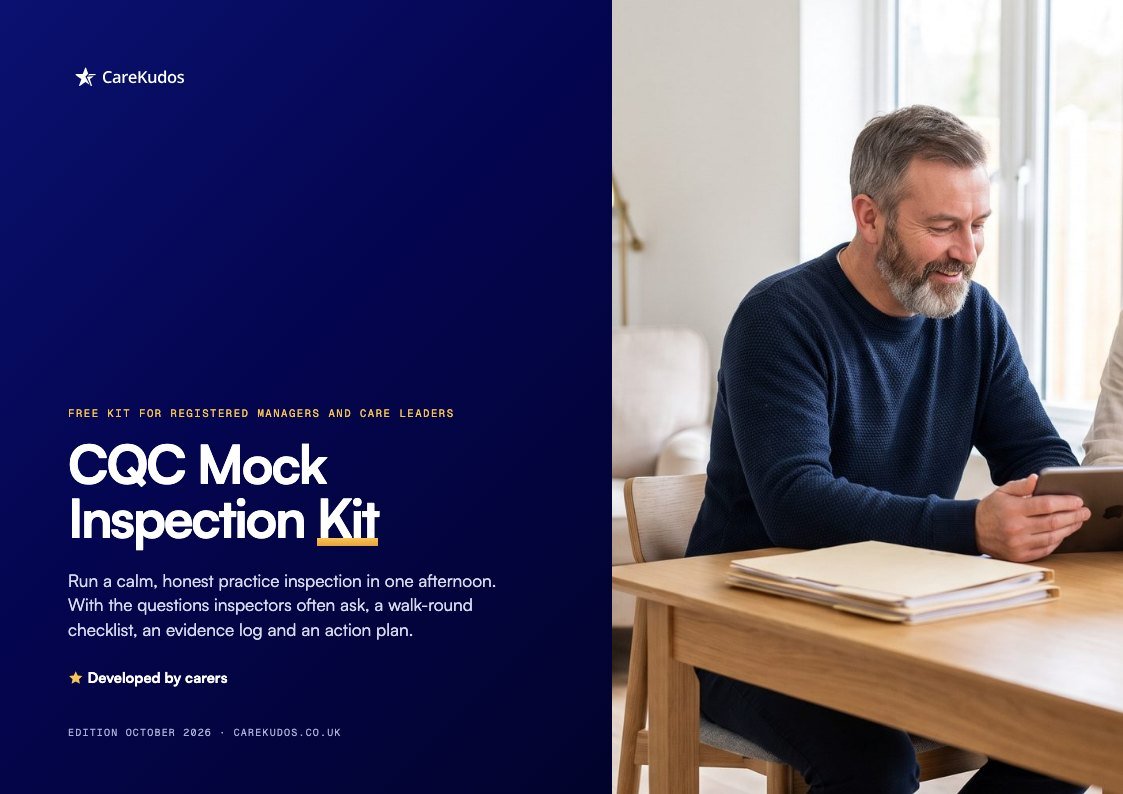
The twelve examples below come from everyday care in care homes, home care and supported living. To test your own evidence, the free CQC mock inspection kit includes the eight questions inspectors put to leaders and an evidence log.
What Well-led means to CQC
CQC describes a well-led service as one with “an inclusive and positive culture of continuous learning and improvement” and “effective governance and management systems”, where information about risks, performance and outcomes is used to improve care.
Under the current single assessment framework, Well-led has eight quality statements: shared direction and culture; capable, compassionate and inclusive leaders; freedom to speak up; workforce equality, diversity and inclusion; governance, management and sustainability; partnerships and communities; learning, improvement and innovation; and environmental sustainability. CQC’s draft framework for adult social care groups the same ground into six key lines of enquiry and leaves environmental sustainability out for now.
adult social care services in England are rated Requires improvement or Inadequate for Well-led, 16% of all services. No key question is missed more often.
CQC open data, October 2026, CareKudos analysis12 examples of Well-led evidence
- 1. A “You said, we did” that is current. A care home updates a board in reception every month with three changes made because of feedback from residents and relatives, each with a date.
- 2. A staff survey that leads to action. A regular anonymous survey, the results shared with the team and two or three actions agreed and followed up.
- 3. Supervision records with follow-through. Notes that show what a carer raised, what the manager did and what happened next. Missed sessions are recorded with the reason.
- 4. An audit that changed practice. A medicines audit found missed signatures. The team introduced a second check at the end of each round, and the re-audit a month later showed the gap had closed.
- 5. Learning from a near miss. A carer spotted a frayed hoist sling before use. It was replaced, all slings were checked and the learning was shared at handover across all shifts.
- 6. A speak-up story. A night carer raised a concern about how one person was moved. The manager investigated, arranged refresher training and told the carer what changed. Staff can name the speak-up route, including outside the service.
- 7. Leaders seen on every shift. Unannounced walk-rounds by the manager on nights and at weekends, logged with what they found and what they changed.
- 8. Specific recognition linked to values. Dated thank-yous from colleagues, managers and families that name what someone did and why it mattered.
- 9. Team meetings with outcomes. Minutes that record decisions and owners, and the next meeting checks they were done.
- 10. Feedback from partners. Comments from GPs, district nurses or social workers, and examples of joined-up care. A home care service keeps notes of regular contact with each local authority it works with.
- 11. Fair support for staff. Wellbeing check-ins, equal access to training and progression, and support for staff who face discrimination from anyone, including people using the service.
- 12. A monthly quality report. One page to the owner, director or board on risks, trends, actions and what improved. A supported living provider writes one for each service and one for the group.
How to make evidence inspection-ready
- Date everything. Evidence over months shows a culture. A folder built the week before shows a project.
- Link it to change. For every piece, say what happened next. Inspectors look for the loop.
- Mix your sources. CQC gathers evidence from people’s experience, feedback from staff and leaders, feedback from partners, observation, processes and outcomes. Cover all six.
- Show the trend. Three months of survey results tell more than one good month.
- Protect privacy. Use initials for residents and remove personal details before you share evidence.
- Keep it findable. One place, sorted by key question, that the person on shift can open without you.
Does staff recognition count as Well-led evidence?
It can, when it is specific, regular and recorded. A dated note that names what a carer did and why it mattered shows a positive culture and leaders who notice good work. One-off awards or vague praise say little. Inspectors judge the whole picture, so recognition supports your evidence and never replaces it.
CQC’s guide for care workers says inspectors look at how a provider shows that staff are valued and supported when they consider whether a service is well-led. One of the questions carers are often asked is simply when they were last thanked for something they did.
How the evidence builds itself
Most services already do the things on this list. The hard part is proving it months later. In CareKudos, recognition from colleagues, managers and families, Good Catch observations and the monthly anonymous Staff Voice survey are captured as they happen. Impact Stories nominated by colleagues and managers add the moments that matter most.
Everything is sorted under CQC’s key questions in an evidence report you can generate for any month or let build itself monthly. Inspector Mode hides names before you share, and the reports are tamper-evident PDFs. The free 30-day pilot ends with your first Well-led evidence report.
Questions managers ask
What does Well-led mean in CQC?
Well-led is one of CQC’s five key questions. It asks whether leadership, management and governance make sure the service provides high-quality, person-centred care, encourages learning and innovation and promotes an open, fair culture.
What are the Well-led quality statements?
There are eight: shared direction and culture; capable, compassionate and inclusive leaders; freedom to speak up; workforce equality, diversity and inclusion; governance, management and sustainability; partnerships and communities; learning, improvement and innovation; and environmental sustainability.
What will change for Well-led in the new framework?
CQC’s draft adult social care framework uses six key lines of enquiry for Well-led: strategic direction, workforce equity and culture, capable and compassionate leaders, governance and management, partnerships and communities, and improvement, innovation and learning. Until the final version is published, the current framework applies.
What evidence do CQC look for under Well-led?
Evidence that leaders know what is happening and act on it: feedback and the response to it, governance and audits with completed actions, supervision and support for staff, learning from incidents, a safe way to speak up and partnerships with other services.
Does staff recognition count as evidence for CQC?
It can, when it is specific, regular and recorded. A dated note that names what a carer did and why it mattered shows caring practice and a positive culture. Recognition supports your evidence and never replaces audits, supervision or care records.
Run a calm practice inspection this month.
Get the free CQC mock inspection kit. The questions inspectors often ask, a walk-round checklist, an evidence log and an action plan, on twelve printable pages. About half a day on site.
CareKudos. Recognition that becomes evidence.
Sources
Facts checked against CQC guidance and CQC open data on 23 October 2026.
- CQC, Single assessment framework: Well-led
- CQC, Draft adult social care assessment framework (March 2026, PDF)
- CQC, Using CQC data: care directory with ratings, October 2026 (Open Government Licence), analysed by CareKudos
- CQC, Care workers’ guide: what to expect during an inspection (updated 26 June 2026)
- CQC, Regulation 17: Good governance (updated 16 May 2025)