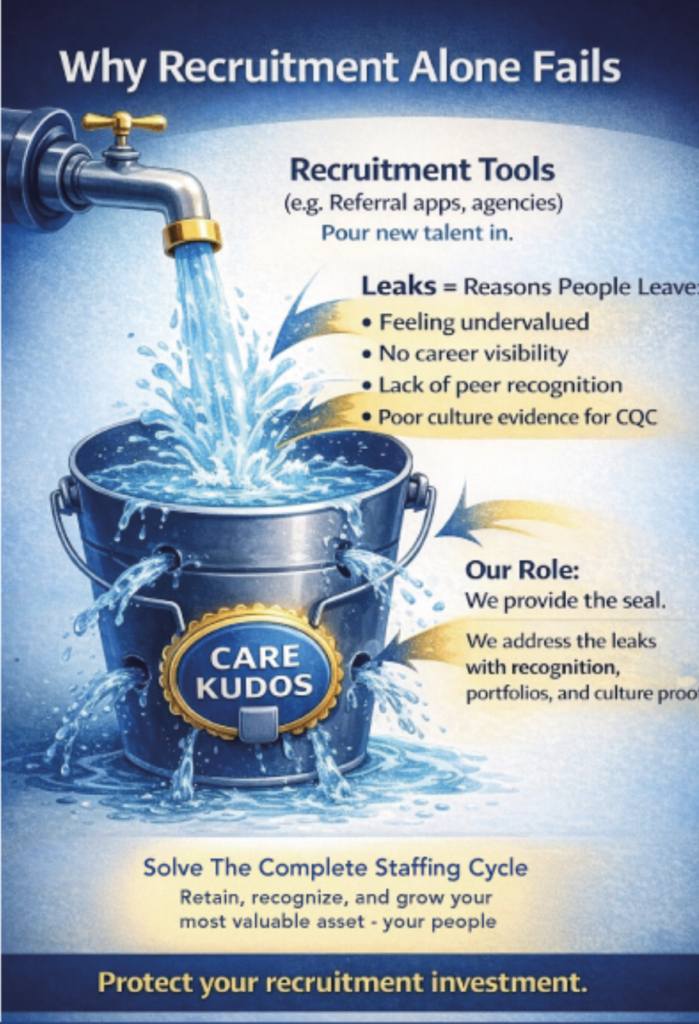
You’re Pouring Water into a Leaky Bucket
If you run a care home, manage a team, or just care about the future of social care – this is for you.
Every day, you hire. You advertise. You interview. You onboard. You invest time and money in finding the right people.
And then, a few months later, they leave.
So you hire again.
The bucket never fills. The leaks never stop.
This is the staffing crisis in UK care homes. And most providers are trying to solve it by pouring faster, more recruitment, more agencies, more sign-on bonuses.
But what if the answer isn’t pouring faster?
What if the answer is fixing the leaks?
This is what happens when care staff retention strategies focus only on hiring.
The Cost of a Leaky Bucket
Let me put some numbers on this.
Every time a care worker leaves, it costs between £3,000 and £13,000. According to recent 2026 workforce data from the Joseph Rowntree Foundation, the median cost to fill a single care worker vacancy is now £7,870 when you factor in recruitment, training, agency cover, and lost productivity.
In a typical care home with 50 staff and 27% annual turnover, that is 13–14 leavers every year. Over £180,000 gone. Every year.
And that is just the financial cost.
There is also the cost of agency staff in care homes, premium rates, continuity gaps, and residents meeting new faces every week. Then there is the cost to team morale. The cost of your own exhaustion as you advertise the same roles again and again.
You are not alone. Across the UK, care homes are trapped in the same cycle.
But here is the thing most homes miss: the problem is not recruitment. The problem is retention.
And if you want to understand why do care workers leave, you have to look beyond pay.
Where Are the Leaks?
If you want to fix a leaky bucket, you need to find the holes.
In care homes, the leaks are well documented. Staff leave because:
- They don’t feel valued
- Their hard work goes unnoticed
- They can’t see a future or career path
- The culture doesn’t recognise good practice
Notice what is not on that list? Pay.
Yes, pay matters. But research consistently shows that feeling undervalued is a stronger predictor of turnover than salary. People leave because they feel invisible.
So how do you improve care home culture? You start by making people feel seen.
Here is what makes people stay:
- Feeling seen and appreciated
- Knowing their work matters
- Seeing a clear path for growth
- Working in a culture that celebrates excellence
These are not expensive fixes. They are structural fixes.
And they are the seals that stop the leaks.
What Do Good Care Staff Retention Strategies Look Like?
Imagine this.
You hire a great care worker. You invest in their induction. They settle in.
But instead of leaving after six months, they stay. They grow. They become a mentor to new staff.
Every £3,000–£13,000 you would have spent replacing them stays in your budget. Your team stabilises. Your residents see familiar faces. Your own stress levels drop.
That is the power of effective care staff retention strategies.
How do you get there?
Start with recognition. Make good work visible. Share achievements. Celebrate the small wins. A simple “thank you” goes further than you think.
Embed your values. Don’t just put them on a wall. Tie recognition to what you stand for. When someone demonstrates compassion or teamwork, acknowledge it.
Show people a future. Career pathways don’t have to be complicated. A clear next step, mentor, senior carer, trainer gives people a reason to stay.
Measure what matters. Track your retention. Know where you are losing people. Spot the patterns before they become crises. And remember: CQC retention evidence is now an explicit part of Well-Led inspections. A stable team is inspectable proof of good culture.
None of this requires a big budget. It requires intention.
A Better Way
At CareKudos, we help care homes do exactly this.
Our platform makes great work visible, ties recognition to your values, and gives managers real-time insight into who is thriving, and who needs support. It is an employee recognition platform for healthcare teams who want to stop churn before it starts.
But you don’t need software to start.
You just need to shift your mindset from “hire more” to “keep better.”
Three Things You Can Do Today
- Ask your staff what would make them stay. Then actually listen.
- Recognise good work publicly. A shout-out in a team meeting. A note on the wall. A quick “thank you” at handover.
- Look at your turnover data. Where are you losing people? What patterns do you see?
Recruitment will always be part of running a care home. But it should not be your only strategy.
The homes that solve the staffing crisis won’t be the ones who hire the fastest. They will be the ones who keep the longest.
That is the goal of every effective care staff retention strategy.
Stop pouring. Start fixing.
Thanks for reading.
If this resonated, please share it with a colleague who needs to see it.
And if you want to learn more about how CareKudos helps care homes fix the leaks, book a discovery call.
Until the next post,
Allen Strong
Founder, CareKudos
P.S. I write about retention, culture, and making care work visible. If someone forwarded you this post.
Thanks for reading!


Great analogy, Allen. The leaky bucket framing really hits home, it’s so easy to default to “just hire more” without stepping back to ask why people are leaving in the first place. The point about feeling invisible being a stronger driver of turnover than pay is something a lot of industries could learn from, not just care. Recognition doesn’t have to be expensive, it just has to be consistent and genuine. The three actionable steps at the end are a nice touch too, practical enough that any care home manager could start tomorrow. Looking forward to more posts like this.
Thanks for such a thoughtful reply, really appreciate it.
You’ve hit on exactly what I was trying to get at: the instinct to pour faster is almost universal, across care and beyond. It feels productive. It’s visible. But it treats the symptom, not the cause. And you’re right that “feeling invisible” isn’t a care sector problem, it’s a workplace problem that care just happens to feel acutely because of the emotional weight of the work.
The consistency point is the one I’d underline most. A one-off award ceremony doesn’t fix a culture. A manager who says “thank you” by name, every week, does. That’s why I kept the three steps deliberately small, the barrier isn’t money, it’s intention.
Thanks again for reading and for the kind words. More to come.