Report
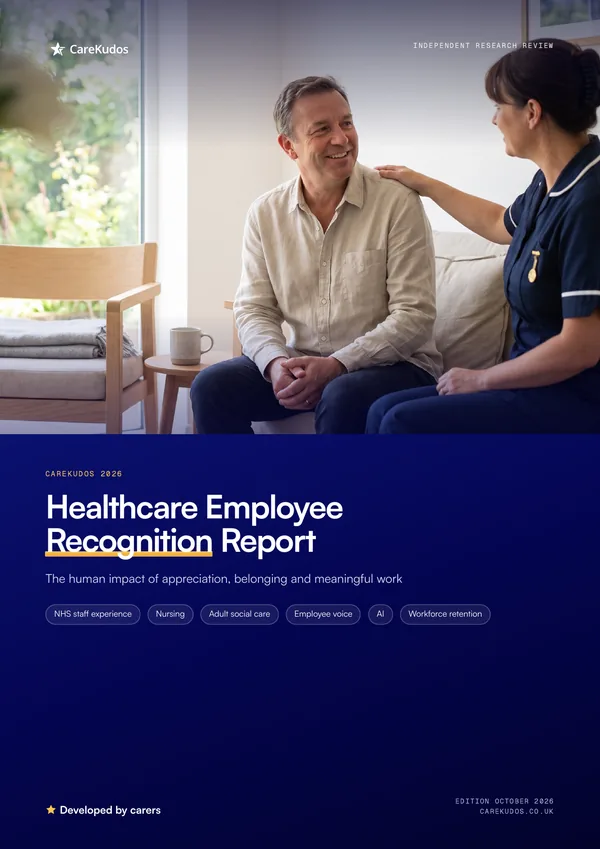
Healthcare Employee Recognition Report 2026
Our 2026 report shows why healthcare staff feel valued by their manager but far less by their organisation, and how leaders can close that gap.
- 17 pages
- 2025 NHS Staff Survey data
- 90-day action plan


Your report is ready.
PDF, 17 pages, A4.
The 2026 Healthcare Employee Recognition Report
The 30% Gap: Why Healthcare Workers Feel Valued by Managers, Not by Organisations
With 18% of US healthcare workers and 17% of US nurses leaving their roles within a year (Press Ganey, Nurse Experience 2025), the disconnect between local appreciation and organisational recognition is a risk leaders cannot afford to ignore. This report breaks down five evidence-based findings:
- The Recognition GapWhy 72.83% of NHS staff feel valued by their manager, but only 42.95% by their organisation (2025 NHS Staff Survey).
- The Clinical DivideWhy clinical staff lag behind non-clinical peers on recognition, voice, and wellbeing.
- Retention and SafetyThe link between recognition, learning culture, and whether nurses stay.
- Adult Social CareRecognition challenges in a sector needing over 400,000 replacement workers by 2035 (Skills England, 2026).
- What Effective Recognition Looks LikeFive principles that make appreciation meaningful across every role and shift.
Read our article on why recognition helps healthcare staff stay.
Key findings
Staff feel valued by their manager. Far less by their organisation.
Three figures from the 2025 NHS Staff Survey, with 766,285 responses, at the heart of the report.
of NHS staff say their immediate manager values their work.
Almost three in four2025 NHS Staff Surveyare satisfied with how much their organisation values their work.
Fewer than half2025 NHS Staff Surveyare satisfied with the recognition they get for good work.
Just over half2025 NHS Staff SurveyA look inside
Three pages from the report.

PDF · 17 pages · A4
What works
Five principles of effective recognition. Here are three.
Tap a principle to see what it means in practice. All five, with examples, are in the report.
Principle 01Recognition is close to the event.What it means
From the reportAppreciation lands hardest soon after the contribution: thanking a nurse after a difficult patient interaction, recognising a porter who kept patient flow moving, or celebrating a team that improved discharge communication.
Principle 02Recognition is specific.What it means
From the reportA strong message describes the contribution and its impact, not just that something good happened. For example: “Thank you for taking additional time to explain the discharge plan to the patient's family. Your clear communication reduced their anxiety.”
Principle 03Recognition includes the whole team.What it means
From the reportHealthcare outcomes are rarely produced by one person alone. Recognition should reach nursing staff, healthcare assistants, administrative colleagues, porters, cleaning and facilities teams, volunteers and family liaison staff, not only the lead clinician.
The action plan
From survey results to a recognition programme in 90 days.
A step-by-step plan, from the first review to measuring what changed.
- First 30 days
Review. Look at your staff survey results, measure satisfaction with recognition and compare clinical and non-clinical roles.
- Days 31 to 60
Define. Set recognition principles, create guidance for managers and add peer nominations, including support roles.
- Days 61 to 90
Launch. Bring recognition into huddles and supervision, start recognition champions and open patient and family nominations.
- After 90 days
Measure. Review who is recognised, compare it with staff-experience scores and adjust the programme based on evidence.
Free · PDF · 17 pages
Questions
Before you download.
Is it free?
Yes. Download the full report as a PDF.
Who is it for?
Leaders and managers in the NHS and in adult social care.
Where do the figures come from?
It is an independent review of published research, such as the 2025 NHS Staff Survey, Skills for Care and Press Ganey. Every source is listed at the end of the report.
Is it about the NHS or social care?
Both. It covers NHS trusts and adult social care.
Will you call me?
Only if you tick the box. Either way, you get instant access to the files.
See the full picture.
Free. 17 pages, with sources and a 90-day action plan.