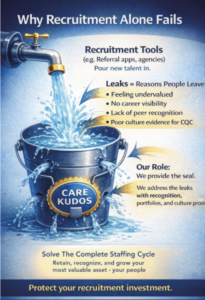
Why Healthcare Recognition Is Retention Infrastructure – Not a Nice-to-Have
A care workforce in crisis, a Prime Minister promising reform, and the everyday culture that will decide whether staff stay.
The people behind the numbers
Around 1.50 million people work in adult social care in England. They fill 1.60 million posts across more than 21,000 sites (Skills for Care; Skills for Care, Latest Workforce Data). They support our parents, our partners, our neighbours. They do it with skill and care. And every year, hundreds of thousands of them walk away.
The latest data from Skills for Care tells the story. In 2024/25, the churn rate for care staff was 23.1%. That is about 335,000 leavers in a single year. For care workers and support workers, churn ran at 28.5% (Skills for Care). The vacancy rate sat at 7.0%. That is about three times the rate of the wider economy. Yet the sector’s value climbed to £77.8 billion — up 12.2% on the year before (Skills for Care, Latest Workforce Data).
These are not just numbers. Each one is a person who could not stay. A team left short. A rota unfilled. A resident who lost a familiar face.
The cost of walking away
High churn is not without cost. It carries a real price tag.
The Joseph Rowntree Foundation found that the median lost-output cost per care-worker vacancy is £9,282. That covers the time to recruit, the time to train, and the months before a new starter is up to speed. Agency cover alone costs a median of £3,684 per departing care worker (JRF). Multiply that across a sector losing a third of a million people a year. The figures are vast.
And it is not only social care feeling the strain. In the NHS, the leaver rate has eased to around 10%. That is one of its lowest levels in over ten years. It is down from a post-pandemic peak of 12.5% (NHS England). That progress is real. It is a credit to the NHS People Promise and the trusts that have spent on keeping staff (NHS England Annual Report 2024–25).
But headline figures hide a sharper truth. In a cross-trust study of nearly 4,735 NHS leavers, 44% were leaving because they were unhappy with their job, their org, or both. Among the push factors they named, reward and praise was cited by one in five (NHS SBS).
When people who care too much leave because they feel unseen, the problem is not drive. It is culture.
A Prime Minister, a promise, and a turning point
In July 2026, Prime Minister Andy Burnham stood in a care home in Golders Green. He set out his pledge to reform adult social care. He promised a National Care Service. He paid tribute to the care workforce. And he was clear about what is at stake: bad levels of unmet need, the high costs of care, and the urgent need for more support for the social care workforce (DHSC).
The reform machinery is now moving. The review led by Baroness Louise Casey has been sped up. Its report is due by summer 2027. Her “Big Conversation on Care” runs until April 2027. It gives families, carers and the public a voice on the future of social care. A cross-gov group, led with Health Secretary Yvette Cooper, will look at growing the Fair Pay Agreement. The goal is to bring the social care workforce closer to NHS standards on pay and career paths (DHSC).
This is the biggest reform moment in a generation. Policy will set the framework. But policy alone does not make a carer feel valued at the end of a twelve-hour shift. That happens in the daily culture of a team. It happens when someone’s work is seen, named and celebrated.
What recognition actually does
Praise is often filed under “rewards and benefits.” A certificate at Christmas. A long-service pin. An annual awards dinner. Those things matter. But the evidence points to something more powerful. Recognition is a retention lever. And a precise one.
Skills for Care found five job factors that shape churn for care workers. They are pay, set hours, full-time hours, training, and skills (Skills for Care). The contrast is striking. People with none of those factors were almost three times more likely to leave. Their churn rate was 42.2%. For those with all five, it was just 14.4% (Skills for Care, Latest Workforce Data). The lesson is clear. Keeping staff is built on planned, real conditions. Praise does not replace pay, hours or training. But it adds to them. It turns decent terms into a culture where people feel valued.
The NHS tells the same story from a different angle. Trusts that spent most on the People Promise Exemplar Programme cut leaver rates 11.8% more than non-exemplar trusts (NHS England). The steps that worked most were not big gestures. They were steady human practices. Flexible working. Local listening sessions. E-rostering that respected people’s time. And, throughout, making sure staff felt seen.
National stages and everyday moments
The UK has well-known national platforms for celebrating care. The HSJ Awards and the NHS Parliamentary Awards recognise the best in patient care, new ideas and leadership. These events matter. They tell the sector that its work is seen and valued at the highest levels.
Beneath those national stages, leading trusts have built something more close. And maybe more powerful. Structured awards that reach into the team and the ward.
The DAISY Award — Diseases Attacking the Immune System — is a global scheme. It was founded by the Barnes family in memory of J. Patrick Barnes, who died in 1999. It honours nurses and midwives for the skill and care they show every day. Winners receive a Healer’s Touch sculpture, a DAISY pin and a certificate. The event takes place in their own ward or dept. It happens in front of the colleagues who know exactly what they did to earn it (Nottingham University Hospitals).
The TULIP Award — Touching Unique Lives in Practice — was launched by Nottingham University Hospitals in late 2019. It does for care support workers what the DAISY does for nurses. It honours care assistants, clinical support staff, theatre staff and nursing associates. These are the non-registered staff whose work is the backbone of patient care. The blue tulip was chosen to mean calm, trust, loyalty and self (Nottingham University Hospitals). Today, trusts including Nottingham University Hospitals and UCLH run DAISY and TULIP side by side. They value both registered staff and the support staff who work with them (UCLH).
And the toolkit keeps growing. Digital platforms such as Culture Cloud, by O.C. Tanner, bring peer-to-peer praise into the daily workflow. Point-based rewards. QR-code nominations from patients. Milestone tracking that meets deskless staff where they actually work (O.C. Tanner). Real touches, from “frontline hero” pins to hand-carved art, give praise something to hold onto.
The common thread is not the format. It is the principle. People stay where they feel seen. They leave where they feel invisible.
The gap that reform alone won’t close
The Prime Minister’s National Care Service is intended to reshape structures, funding and standards. Baroness Casey’s review will define the bigger questions. The Fair Pay Agreement may finally narrow the pay gap with the NHS (DHSC).
None of that, on its own, will make a care assistant feel that their twelve-hour shift was noticed.
Praise is the link between national reform and daily reality. It is how a policy pledge to “value the workforce” becomes a real moment. A moment in which a manager says, by name, what someone did well today. It is one of the most cheap, fast and human retention tools available. And it is the one most often treated as optional.
Where Carekudos comes in
Carekudos exists to close exactly this gap. We help care providers build praise that is not a once-a-year ceremony but a daily practice. Visible. Fair. Easy to give. Meaningful to receive.
Our approach is built on the evidence in this blog. We know that praise works best when it is specific, timely and fair. When it reaches the support worker as readily as the nurse. When it reaches the night shift as readily as the day. A platform like Carekudos helps leaders make praise easier to give. More steady across roles and shifts. And more visible as part of daily management.
Because the goal is not awards. The goal is a team that stays. A team that feels valued for the role each person plays in someone’s care. And that carries that feeling into the next shift, and the next.
The moment to act
The care sector stands at a rare point. A Prime Minister set on reform. A review reshaping the future. And a workforce that has never needed more reasons to stay (DHSC).
Praise will not, on its own, fix the retention crisis. Pay, staffing levels, career paths and workloads all matter. But praise is the lever that leaders can pull today. Without new laws. Without budget cycles. Without waiting for summer 2027.
If you are responsible for a care team, the question is not whether your staff deserve praise. They do. The question is whether your org has made it easy, fair and human enough to actually happen.
Ready to make recognition part of your retention strategy?
Book a Carekudos demo and see how simple, daily praise can help your team feel valued — and stay.
Arrange a call with our team · Request a demo
Carekudos – recognition that helps people stay.
Sources
- The Prime Minister’s Commitment to Adult Social Care — DHSC / socialcare.blog.gov.uk, August 2026: https://socialcare.blog.gov.uk/2026/08/06/the-prime-ministers-commitment-to-adult-social-care/
- Skills for Care, The state of the adult social care sector and workforce in England 2025 (Executive Summary): https://www.skillsforcare.org.uk/Adult-Social-Care-Workforce-Data/workforceintelligence/resources/Reports/National/The-state-of-the-adult-social-care-sector-and-workforce-in-England-2025-Executive-Summary.pdf
- Skills for Care, Latest social care sector and workforce data published (October 2025): https://www.skillsforcare.org.uk/news-and-events/news/latest-social-care-sector-and-workforce-data-published
- Skills for Care, Retaining more people: https://www.skillsforcare.org.uk/About-us/Our-policy-positions/Capacity/Retaining-more-people.aspx
- NHS England, Staff leaving the NHS among lowest in over a decade (March 2025): https://www.england.nhs.uk/2025/03/staff-leaving-the-nhs-among-lowest-in-over-a-decade/
- NHS England Annual Report and Accounts 2024–25: https://assets.publishing.service.gov.uk/media/69036ef05c84b1206832a86f/nhs-england-annual-report-and-accounts-2024-to-2025.pdf
- NHS SBS, NHS leavers ‘care too much not too little’ (May 2026): https://www.sbs.nhs.uk/news/nhs-leavers-care-too-much-not-too-little/
- Joseph Rowntree Foundation, The hidden cost of low pay in the social care sector: https://www.jrf.org.uk/care/the-hidden-cost-of-low-pay-in-the-social-care-sector
- Nottingham University Hospitals, The DAISY Awards: https://www.nuh.nhs.uk/the-daisy-awards/
- Nottingham University Hospitals, The TULIP Awards: https://www.nuh.nhs.uk/the-tulip-awards/
- UCLH, Rewards and Recognition (DAISY & Tulip Awards): https://www.uclh.nhs.uk/work-with-us/why-choose-uclh/your-health-and-wellbeing/rewards-and-recognition
- O.C. Tanner, Culture Cloud — Healthcare Industry Solutions: https://www.octanner.com/solutions/healthcare
- Institute for Government, Performance Tracker 2025: Hospitals: https://www.instituteforgovernment.org.uk/publication/performance-tracker-2025/nhs/hospitals