What questions do CQC inspectors ask care staff?
CQC inspectors ask care staff about the people they support, how they keep them safe, what they would do about a safeguarding concern, how they raise worries and the support and training they get. Inspectors want a true picture of daily care, so the strongest answers use a real, recent example and say what changed.
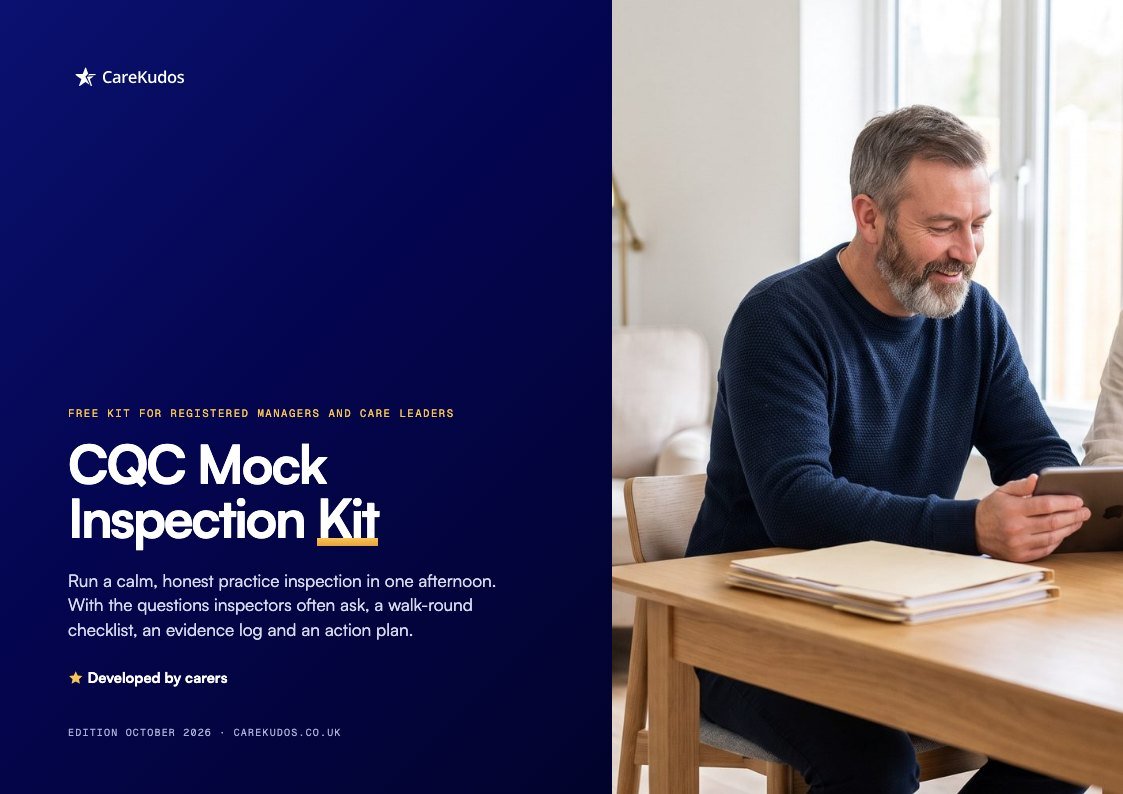
Below are 28 questions inspectors often ask, grouped by CQC’s five key questions, with what a strong answer shows. If you would like them on paper, the free CQC mock inspection kit has them ready to print, together with a walk-round checklist and an action plan.
What inspectors want to hear from carers
CQC’s own guide for care workers, updated in June 2026, names four things inspectors want to learn from the people doing the work:
- What you enjoy about your role. What you love about working there, the difference you make and the moments you are proud of. Inspectors value real stories.
- Your experience of raising concerns. If you have raised a worry about care, were you listened to, and what happened next?
- How you support people day to day. What you know about the people you care for, how you meet their needs and how the team shares information.
- The support you get in your role. Your line manager, where you go when you need help, and whether your training prepared you.
Inspectors also watch. They observe everyday moments between staff and the people they support, and they check whether the staffing rota matches the staff on duty. CQC says warm, natural contact counts: holding someone’s hand or giving a hug, when the person welcomes it, can be evidence of caring and compassionate support.
28 questions inspectors often ask care staff
The questions follow the five key questions CQC asks of every service: is it safe, effective, caring, responsive and well-led? Inspectors do not read from a fixed script, so use the list as a map of the ground they usually cover.
Safe
- What would you do if you were worried someone was being harmed or neglected?
- Who is the safeguarding lead here, and who would you contact outside the service?
- How would you raise a concern about a colleague’s practice?
- Tell me about a risk you noticed recently. What did you do?
- What do you do if a medicine is missed or given wrongly?
- How do you stop infection spreading?
- Are there enough staff on your shifts to give people the time they need?
A strong answer puts the person’s safety first, reports the same day and knows the route, including the local authority safeguarding team. The best examples end with what changed afterwards.
Effective
- What training have you had this year, and what helped you most?
- How did your induction prepare you for the job?
- How do you know when someone’s needs have changed?
- How do you check someone agrees to their care, and what happens if they can’t decide?
- How do you help people eat and drink well?
- How do you work with GPs, district nurses and other professionals?
A strong answer links training to the people the carer supports, explains mental capacity in plain words and names who they tell when something changes.
Caring
- Tell me about someone you support. What matters to them?
- How do you protect people’s dignity and privacy during personal care?
- How do you comfort someone who is upset or anxious?
- How do you find out what someone likes when they can’t tell you?
- What are you most proud of in your work here?
A strong answer talks about the person, their history and what they enjoy, well beyond the tasks of the day.
Responsive
- How do you make sure care plans stay personal and up to date?
- Do you have time to read care plans, and how do you hear about changes?
- What would you do if someone wanted to make a complaint?
- How do you help people keep up their interests, faith and relationships?
- How do you support someone at the end of their life?
A strong answer shows the carer helps shape the plan, takes a complaint seriously the same day and knows the person’s wishes.
Well-led
- Do you feel supported? Who do you call out of hours?
- When did you last have supervision, and was it useful?
- Have you ever raised a concern? What happened next?
- How does the team learn when something goes wrong?
- When were you last thanked for something you did?
A strong answer names a manager who listens, a supervision that led somewhere and a recent, specific thank-you. Inspectors look at how a provider shows that staff are valued and supported when they judge whether a service is well-led.
How to prepare your team without scripting anyone
Inspectors notice rehearsed lines, and CQC asks staff simply to be themselves. Good preparation builds confidence in real examples, so carers can talk about their work the way they talk to each other.
- Take one key question a week. Use five minutes of a handover or team meeting to talk through two or three of the questions above.
- Collect real moments. Ask each carer to remember two recent examples they are proud of and one time they spoke up. Real stories are easier to recall under pressure than any script.
- Make the routes visible. Put the safeguarding lead, the out-of-hours number and the local authority contact where every shift can see them.
- Explain staff rights. Carers can speak to inspectors in private, ask to talk later when they are busy, and give feedback off shift through CQC’s online Give feedback on care form, anonymously if they wish.
- Include nights and weekends. Unannounced inspections can happen at any time, and CQC may visit in the evening, at night or at the weekend.
- Keep it calm. A short practice chat in pairs works better than a quiz. Anxious staff forget what they know.
The best preparation is a service where the honest answer is already a good one.
What inspectors notice beyond the answers
Inspectors put what staff say next to what they see and read. A carer who mentions regular supervision should match a supervision record. A risk that was “reported straight away” should appear in the incident log, with the action that followed. Inspectors also talk to people who use the service, their relatives and visiting professionals, and they notice when the stories line up.
Where people can’t easily tell inspectors about their care, observation carries more weight. Mealtimes, a medicines round and the way staff respond to someone who is distressed often say more than any folder.
How the evidence builds itself
Carers often freeze when an inspector asks for an example, even when they have dozens. A record of everyday good practice helps them remember. In CareKudos, staff and managers post short recognition moments from their own phone, each linked to one of your values. Every post is checked for personal details before it goes live, and residents appear by initials only.
The moments are sorted under CQC’s key questions in a monthly evidence report. Before an inspection, a carer can look back at their own recognised work and find the story that answers the question. CareKudos sits alongside your supervision records, care plans and audits. It adds the daily picture of good practice that is otherwise easy to lose.
Questions managers ask
What questions will CQC ask?
Inspectors ask staff, people who use the service and their relatives about safety, care, support and leadership. With care staff they focus on the people you support, safeguarding, raising concerns, training and supervision. With managers they ask how you know care is safe and good, and what you have improved.
What are the CQC 5 key questions?
CQC asks whether a service is safe, effective, caring, responsive and well-led. It rates each of the five as Outstanding, Good, Requires improvement or Inadequate, and then gives the service an overall rating.
Are CQC still using key lines of enquiry (KLOEs)?
Not at the moment. Under the single assessment framework CQC uses 34 quality statements. Its draft framework for adult social care, published in March 2026, brings back key lines of enquiry: 24 of them, replacing the quality statements once the final version is in place. Until then, the current framework applies.
Can my manager sit in when an inspector talks to me?
That is your choice. CQC says care workers have the right to speak with inspectors independently, and inspectors advise against managers joining these conversations. If you would prefer your manager to be there, inspectors will respect that and make sure you can still contact them separately.
How do you pass a CQC inspection?
There is no pass or fail. CQC rates each key question and the service overall. The best preparation is daily practice that matches your policies, staff who know the people they support well, and evidence that is dated and easy to find.
Do CQC inspectors talk to night staff?
They can. Unannounced inspections can take place at any time, including evenings, nights and weekends. Staff who are off shift can also share their views through CQC’s online feedback form.
Run a calm practice inspection this month.
Get the free CQC mock inspection kit. The questions inspectors often ask, a walk-round checklist, an evidence log and an action plan, on twelve printable pages. About half a day on site.
CareKudos. Recognition that becomes evidence.
Sources
Facts checked against CQC guidance on 23 October 2026.
- CQC, Care workers’ guide: what to expect during an inspection (updated 26 June 2026)
- CQC, Purpose of CQC’s assessment frameworks (updated 14 April 2026)
- CQC, Give your views on draft sector-specific assessment frameworks (updated 15 June 2026)
- CQC, Draft adult social care assessment framework (March 2026, PDF)
- CareKudos, CQC mock inspection kit