What is a mock CQC inspection?
A mock CQC inspection is a practice inspection. Someone looks at your service the way an inspector would: they talk to people, relatives and staff, observe care, check records and walk round, then turn what they find into an action plan. You can run one yourself in an afternoon, or pay a consultant for an outside view.
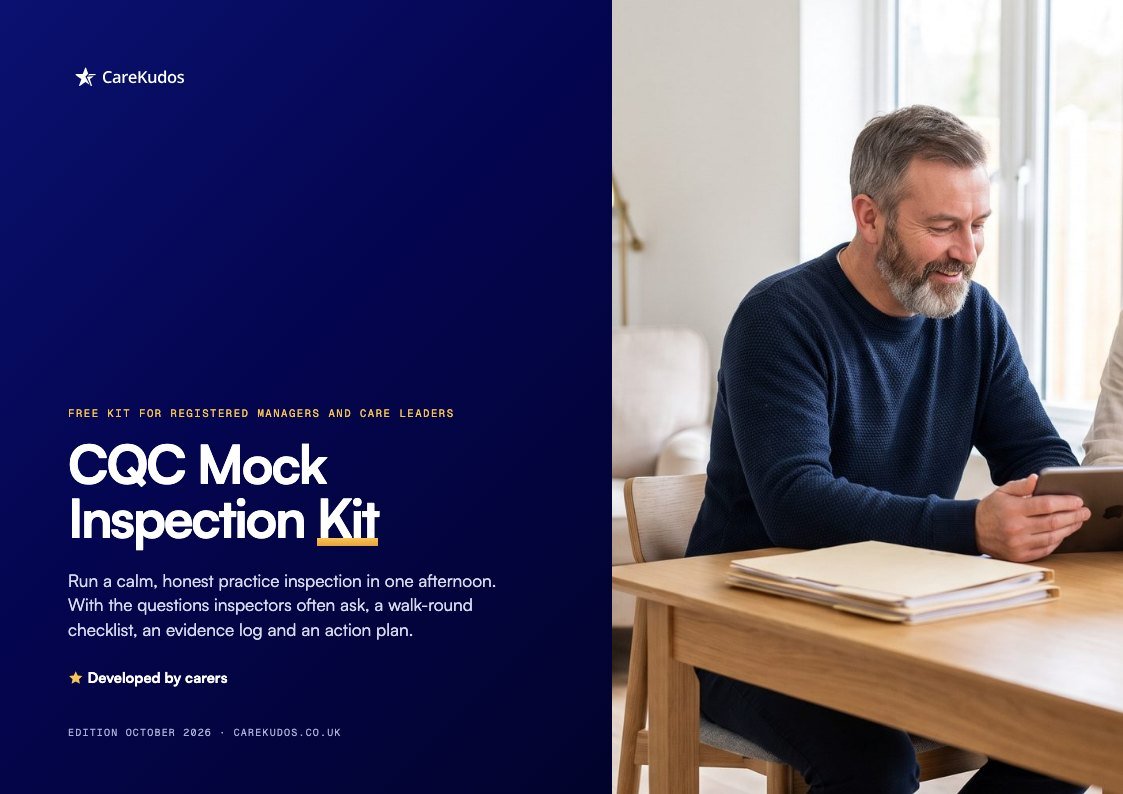
This guide covers both routes. For the do-it-yourself route, the free CQC mock inspection kit gives you the questions, the walk-round checklist, an evidence log and an action plan on twelve printable pages.
Why a practice run makes sense now
of rated adult social care services in England had a rating more than three years old on 1 October 2026: 15,686 of 22,722.
CQC open data, CareKudos analysisCQC decides by risk when to assess a service, and it gives no fixed date. Most care home inspections are unannounced. Many services were last rated under a framework that has since changed, and CQC is preparing another new framework for adult social care. A practice run shows you what an inspector would see, while there is still time to act.
Good moments for a mock inspection include a new registered manager, a run of incidents or complaints, a big change in the people you support, the end of building work, or simply a rating that is more than two years old.
What a mock inspection covers
A useful practice run uses the same sources of evidence CQC uses. The current framework names six of them:
- People’s experience of the care they receive, and their relatives’ views.
- Feedback from staff and leaders, on days, nights and weekends.
- Feedback from partners such as GPs, district nurses and social workers.
- Observation of care, mealtimes, medicines rounds and the environment.
- Processes: care plans, audits, policies, training and supervision records.
- Outcomes: what is actually better for people over time.
How to run it yourself: eight steps
- Pick a lead and a date. Choose someone who is not running the shift that day: a deputy, a manager from a sister service or a trusted peer.
- Set the scope. All five key questions, or the two you feel least sure about.
- Start with people. Ask how their day is going, whether they feel safe and whether staff know what matters to them.
- Talk to staff in private. Include nights. Use the 28 questions inspectors often ask.
- Observe. A mealtime, a medicines round and a handover.
- Sample records. Care plans, medicines records, incidents, complaints, training, supervision and audits.
- Walk round. Cleanliness, equipment, fire doors, hand hygiene and whether the rota matches the staff on duty.
- Write it up and plan. Sort findings by key question. Give each one an owner, a date and a risk level.
Suggested timings for a care home of around 40 beds. A smaller service, or a focused run on two key questions, takes less.
| Part | Time |
|---|---|
| Talking to people and relatives | 45 min |
| Staff conversations, six to eight staff | 60 min |
| Observation | 30 to 45 min |
| Records sample | 45 min |
| Walk-round | 30 min |
| Write-up and action plan | 30 min |
| Total on site | about 4 hours |
In home care, swap the walk-round for two or three visits with consent from the people you support, and add a check of call times and missed visits. In supported living, include at least one house or flat you visit less often.
Run it yourself or hire a consultant?
Both routes work. The right choice depends on what you need from the exercise.
| Run it yourself | Hire a consultant | |
|---|---|---|
| Cost | Staff time only | A day rate or a fixed fee |
| Fresh eyes | Limited, unless a peer from another service leads it | An outside view with no history in the team |
| How staff feel | Familiar faces, less anxiety | Closer to the real thing |
| Ownership | Your team owns the plan from day one | Check what support is included after the report |
| Best for | Regular checks, once or twice a year and after changes | A first baseline, after a weak rating, or before a big change |
If you hire a consultant, ask for a sample report, how they grade findings, whether they talk to people who use the service and to night staff, and what follow-up is included in the price. Ask too how they keep up with CQC’s approach, because the framework is changing.
Five mistakes that waste a mock inspection
- Treating it as a test. Staff hide problems when they feel judged. Say clearly that it is about learning and nobody will be blamed.
- Only checking paperwork. Inspectors start with people’s experience. So should you.
- Skipping nights and weekends. Unannounced inspections can happen at any time.
- Findings without owners. A list of problems with no names or dates changes nothing.
- No re-check. Book a short follow-up four to six weeks later to see whether the actions were done.
How the evidence builds itself
Practice inspections often show the same gap: good care that nobody wrote down. In CareKudos, staff and managers capture everyday moments as they happen, and the monthly evidence report sorts them under CQC’s key questions. Good Catch records safety observations and what changed as a result, and the monthly anonymous Staff Voice survey shows how the team feels over time.
When you run your next practice inspection, that evidence is already dated and in one place. Inspector Mode hides names before you share a report.
Questions managers ask
What is the meaning of “mock inspection”?
A mock inspection is a rehearsal of a real CQC inspection. It follows the same steps, from talking to people and staff to checking records, so you find gaps before an inspector does and can fix them on your own timetable.
How often should we run a mock CQC inspection?
There is no rule. A full practice run once or twice a year works well for most services, with a short focused check after a big change, such as a new manager or a run of incidents.
Should we tell staff in advance?
Yes, tell them it will happen and why: to learn and improve, with no blame. You can keep the exact day open so you see a normal shift.
Who should lead the mock inspection?
Someone outside the daily running of the service, such as a deputy from another site, a peer manager or a consultant. The registered manager should own the action plan that comes out of it.
What happens if you fail a CQC inspection?
There is no pass or fail. CQC rates each key question and the service overall as Outstanding, Good, Requires improvement or Inadequate. If it finds a breach of the regulations, it can ask for an action plan and will assess again. Our 90-day plan after a Requires improvement rating shows what to do next.
Is a mock inspection the same as an audit?
They work together. An audit checks one area against a standard, such as medicines or infection control. A mock inspection looks across the whole service through the five key questions, and starts with people’s experience.
Run a calm practice inspection this month.
Get the free CQC mock inspection kit. The questions inspectors often ask, a walk-round checklist, an evidence log and an action plan, on twelve printable pages. About half a day on site.
CareKudos. Recognition that becomes evidence.
Sources
Facts checked against CQC guidance and CQC open data on 23 October 2026.
- CQC, Using CQC data: care directory with ratings, snapshot of 1 October 2026 (Open Government Licence), analysed by CareKudos
- CQC, Care workers’ guide: what to expect during an inspection (updated 26 June 2026)
- CQC, How often we assess (updated 12 November 2025)
- CQC, Give your views on draft sector-specific assessment frameworks (updated 15 June 2026)
- CareKudos, CQC mock inspection kit