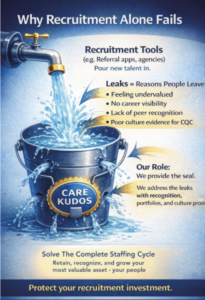
The ROI of Staff Recognition Programmes in Care
What every £1 invested in recognition actually returns – and why care providers can no longer afford to treat it as optional.
When praise stops being “nice to have”
For years, staff recognition has sat in the same budget as the Christmas party. Leaders want to do it. They feel they should. But they struggle to justify it when finance asks for a business case.
That is changing. The care sector loses about 335,000 staff a year. The turnover rate is 23.1% (Skills for Care, State of the Adult Social Care Sector 2025). The cost of not valuing your team is no longer hidden. It shows up in agency bills. It shows up in empty shifts. It shows up in CQC reports. And it shows up in the slow loss of the people who hold your service together.
This article makes the money case. It uses real research. It applies it to UK care. The question is no longer whether you can afford to invest in praise. It is whether you can afford not to.
The hidden cost of every exit
Before working out what praise returns, you need to know what churn costs. And churn costs a lot.
The Joseph Rowntree Foundation ran one of the most detailed UK studies on care-worker churn costs. The results are stark:
- The median lost-output cost per vacancy is £9,282. This covers the time to recruit, the time to train, and the months before a new starter works at full speed.
- The median agency cost per departing care worker is £3,684.
- The total cost per vacancy, combining lost output and agency cover, reaches about £12,966 (Joseph Rowntree Foundation).
Other estimates put the cost of replacing a care worker at £3,000 to £6,000 in direct recruitment and training (Q Care Group). For senior roles, costs can top £10,000.
Now apply this to a typical care home. A 50-bed service with 50 staff loses about 15 team members a year. At a low £5,000 per exit, that is £75,000 lost each year. That is before agency costs, overtime, or lost beds.
Poor staff wellbeing costs the NHS about £12.1 billion a year. This breaks down into presenteeism (£6.07 billion), sickness absence (£3.79 billion), and bank and agency costs (£2.24 billion) (IPPO/EPPI-UCL).
Every leaver carries a price tag. Praise cuts how many you pay.
What the research says about recognition ROI
The evidence is clear. Three sources stand out.
Altrum modelled the ROI of staff recognition. They used data from the Aberdeen Group and Gallup. They looked at scenarios from low to high. The ROI of investing 1% of payroll in praise ranged from 93% to 693%. Every £1 spent returned between £1.93 and £7.93 (Altrum). The benefits were costs avoided: less churn, lower absence, and fewer lost staff.
Workhuman used its iQ data and research with Gallup. It estimates that a 10,000-person org can save up to $16.1 million a year in churn costs. Its ROI calculator models returns of 3.7x to 7.5x on praise spend (Workhuman; Workhuman ROI Calculator).
Gallup, cited by Altrum and Workhuman, found that praise can cut absence rates by 27% (Altrum). Altrum also reports that 79% of staff who leave cite lack of praise. The source is not specified (Altrum). The Aberdeen Group found that companies with a praise scheme have 31% lower churn than those without (Altrum/Aberdeen Group).
Why ROI can be especially strong in care
The ROI of recognition is not the same across all fields. In healthcare, the data shows it can be very strong. The reasons are clear.
Bucketlist Rewards analysed eight years of data across 800+ healthcare orgs and 5 million praise moments. This is vendor data. It found that praised healthcare staff report:
- 1.2x higher engagement — more motivated staff
- 1.4x higher satisfaction — staff who feel valued
- 1.4x more likely to stay — less churn
- 10% less burnout — better patient care
The vendor data also suggests praise moments are twice as likely to boost retention in healthcare (Bucketlist Rewards). ClearView Healthcare, a Bucketlist customer, saw a 20% rise in retention and a 50% drop in agency staffing (Bucketlist Rewards).
In Workhuman examples, Cisco saw a 3x cut in churn when praise was funded at 1% of payroll. Staff with one to three years of service and strong praise showed 4.5x lower flight risk (Workhuman).
The ROI in healthcare is higher. The costs it prevents are higher too. Healthcare churn costs more to fix. Clinical roles cost more to replace. Burnout hits patient care directly. And agency staffing is very costly. When praise prevents even a fraction of these costs, the return adds up fast.
A worked example: what recognition could save your care home
Let us turn the research into a real example. The numbers are striking.
The org: A 50-bed care home with 50 staff. We use an average pay of £23,000.
| Measure | Figure | Source |
| Yearly payroll | £1,150,000 | 50 staff × £23,000 |
| Churn rate | 28.5% (approx. 14–15 leavers/year) | Skills for Care |
| Cost per leaver | £5,000–£12,966 | Q Care Group / JRF |
| Yearly churn cost | £70,000–£194,490 | 14–15 leavers × cost range |
| Praise spend (1% of payroll) | £11,500 | SHRM/Altrum benchmark |
The scenario: This home spends £11,500 on a structured praise scheme. That is 1% of payroll. SHRM says this is the minimum to see positive results (Altrum). JRF’s lost-output cost is £9,282. Add the agency cost of £3,684. The combined cost per exit can reach about £12,966 (JRF).
The return: The Aberdeen Group found 31% lower churn with praise schemes. Applied here, churn could drop from 15 to about 10 leavers. That is 5 fewer exits.
| Outcome | Low | Mid | High |
| Leavers avoided | 3 | 4 | 5 |
| Savings per leaver | £5,000 | £8,000 | £12,966 |
| Total savings | £15,000 | £32,000 | £64,830 |
| Praise spend | £11,500 | £11,500 | £11,500 |
| Net benefit | £3,500 | £20,500 | £53,330 |
| ROI | 30% | 178% | 464% |
| Return per £1 spent | £1.30 | £2.78 | £5.64 |
This is churn savings alone. It does not include other gains:
- Less agency costs — ClearView Healthcare cut agency use by 50% (Bucketlist Rewards)
- Lower absence — Gallup found praise cuts absence rates by 27% (Altrum)
- Less burnout — healthcare staff with praise report 10% less burnout (vendor data, Bucketlist Rewards)
- CQC alignment — workforce wellbeing is now part of the CQC “Caring” key question. Inspectors will speak with staff about wellbeing (CQC; Skills for Care)
Add even one of these extra savings, and the ROI grows fast.
Why ROI can be especially strong in care
The reason recognition ROI can be very strong in healthcare comes down to five factors. Each one adds to the return.
- Churn costs are higher. Replacing a care worker costs up to £12,966 in lost output alone (JRF). Every exit prevented saves more than in most fields.
- Agency dependency is costly. The NHS alone spends £2.24 billion a year on bank and agency staff to cover gaps caused by poor wellbeing (IPPO/EPPI-UCL).
- Burnout has direct care consequences. Staff who are burned out give lower-quality care. Praise is linked to 10% less burnout in care settings (vendor data, Bucketlist Rewards). Better-supported staff give better person-centred care.
- Retention impact is double. Praise moments are twice as likely to boost retention in healthcare than in other fields (Bucketlist Rewards). The same spend works harder.
- CQC now expects it. The CQC framework includes “Workforce wellbeing and enablement” under its “Caring” key question. Inspectors will look for evidence that staff wellbeing is supported. Praise is one of the clearest ways to show this (CQC).
The cost of doing nothing
The research is clear. Companies without praise schemes have 31% higher churn (Altrum/Aberdeen Group). And 79% of staff who leave cite lack of praise as a key reason (Altrum).
In a sector where each exit can cost up to £12,966, doing nothing is costly. The NHS loses about £12.1 billion a year to poor staff wellbeing (IPPO/EPPI-UCL). The CQC now checks workforce culture. Doing nothing is the most costly choice you can make.
Where Carekudos comes in
Carekudos helps care providers turn praise from a yearly gesture into a daily practice. We work on three things that matter to your bottom line and your CQC rating: recognition, portfolios, and culture proof.
Our approach is built on the evidence in this article. We help you invest in praise at the level the research shows is effective. That is about 1% of payroll. And we help you see the return in less churn, lower agency use, stronger wellbeing, and the culture proof that CQC inspectors now look for.
Praise is not a cost. It is one of the most accessible retention tools you can act on fast. And in healthcare, the return can be very high.
The question for your org
If a 50-bed care home can save £15,000 to £65,000 a year by spending £11,500 on recognition, the question is not whether praise has an ROI. The research has settled that.
The question is whether your service has a scheme set up to deliver it.
Ready to calculate what praise could save your org?
Book a Carekudos demo. We will walk you through the ROI for your service — with real numbers based on your churn, agency spend, and payroll.
Arrange a call with our team · Request a demo
Carekudos – recognition that pays for itself.
Sources
- Skills for Care, The State of the Adult Social Care Sector and Workforce in England 2025 (Executive Summary): https://www.skillsforcare.org.uk/Adult-Social-Care-Workforce-Data/workforceintelligence/resources/Reports/National/The-state-of-the-adult-social-care-sector-and-workforce-in-England-2025-Executive-Summary.pdf
- Joseph Rowntree Foundation, The Hidden Cost of Low Pay in the Social Care Sector: https://www.jrf.org.uk/care/the-hidden-cost-of-low-pay-in-the-social-care-sector
- Altrum, The Measurable ROI of Employee Recognition: https://www.altrum.com/resources/recognition/the-measurable-roi-of-employee-recognition/
- Workhuman, ROI of Employee Recognition: Benefits, Data, and Business Impact: https://www.workhuman.com/blog/roi-of-employee-recognition/
- Workhuman, ROI Calculator: https://www.workhuman.com/roi-calculator/
- Bucketlist Rewards, 5 Proven Recognition Strategies in Healthcare: https://bucketlistrewards.com/blog/5-proven-recognition-strategies-in-healthcare/
- Q Care Group, How Much Does Staff Turnover Really Cost Care Providers?: https://www.qcaregroup.co.uk/latest-news/how-much-does-staff-turnover-really-cost-care-providers
- IPPO/EPPI-UCL, NHS Staff Wellbeing: Why Investing in Organisational and…: https://eppi.ioe.ac.uk/cms/Default.aspx?tabid=3861
- Deloitte UK / Evolve Workplace Wellbeing (2025), cited in IPPO/EPPI-UCL analysis of NHS staff wellbeing costs.
- CQC, Workforce Wellbeing and Enablement (Single Assessment Framework): https://www.cqc.org.uk/guidance-regulation/providers/assessment/single-assessment-framework/caring/workforce-wellbeing-enablement
- Skills for Care, CQC Inspection Toolkit — Workforce Wellbeing: https://www.skillsforcare.org.uk/Support-for-leaders-and-managers/Good-and-outstanding-care/inspection-toolkit/Topic-recommendations.aspx?kloe=caring-1&topic=workforce-wellbeing-and-enablement&services=residential-homes-including-nursing-care-services-2
- SHRM (Society for Human Resource Management), cited in Altrum regarding the 1% of payroll recognition investment threshold.
- Aberdeen Group, cited in Altrum regarding 31% lower turnover at companies with recognition programmes.
- Gallup, cited in Altrum and Workhuman regarding absenteeism reduction (27%) and the Unleashing the Human Element at Work report ($16.1M savings for 10,000-person organisations).